- Home
- Sustainability
- Governance
- Compliance
Compliance
Approach to Compliance
The group recognizes compliance as one of the most important aspects of promoting sustainable management and has identified it as a material issue. Furthermore, our Charter of Corporate Behavior and Code of Conduct for Executives and Employees mandate strict adherence to laws and regulations based on our Corporate Philosophy. In addition to legal compliance, the group also promotes adherence to the Charter of Corporate Behavior, various regulations, societal rules, customs, and other social norms through education provided to executives and employees. To ensure thorough implementation, we promote compliance within each organization through the OVOL Sustainability Promotion Meetings, under the direction of the Executive Sustainability Committee.
Charter of Corporate Behavior and Code of Conduct for Executives and Employees
The Japan Pulp & Paper Group’s Charter of Corporate Behavior is a guide for ensuring that all executives and employees recognize the values we have cultivated over the years and constantly embody them. It is also part of our efforts to further promote a more proactive sustainable management.
The Code of Conduct for Executives and Employees defines the values and actions that should be pursued by executives and employees of the group in their daily business activities. We will ensure that all executives and employees are fully aware of these charters, norms, and policies, and work to foster a stronger understanding of compliance.
Japan Pulp & Paper Group Charter of Corporate Behavior
- Contributing to Society through Business Activities
- Compliance with Laws and Regulations
- Promoting Environmental Protection
- Respect for Human Rights
- Diversity
- Fair and Appropriate Business Practices and Responsible Sourcing
- Healthy and Safe Working Environment
- Thoroughgoing Risk and Crisis Management
- Harmonious Coexistence and Coprosperity with Stakeholders
Free, Fair, and Transparent Business Activities
The Japan Pulp & Paper Group’s Code of Conduct for Executives and Employees states that we comply with the competition laws of each country and region we serve, work to prevent violations, and that we will establish internal systems to correct violations should they occur. We also prohibit bribery and any other acts that may be suspected of offering benefits that may be deemed as being for illicit gain; forbid the giving and receiving of gifts, entertainment, and other economic benefits beyond the scope of social etiquette; and require employees to refrain from any involvement in illicit business transactions and money laundering.
In line with this code, the group has established the Antimonopoly Law Compliance Policy and Anti-Corruption Policy to set clear standards of conduct. We also declare our commitment to building internal frameworks that include regular education and training for executive and employees, as well as periodic audits.
[Related link]
Taxation Compliance
The Japan Pulp & Paper Group’s Taxation Policy states its commitment to contributing to economic and social development and the interests of all stakeholders by paying appropriate taxes in accordance with the relevant laws and regulations of all countries and regions where it operates. The policy also clarifies our basic approach to tax compliance.
For important tax-related issues, the group receives advice from external experts and consults with tax authorities in advance, as necessary, in order to minimize tax risks.
[Related link]
Initiatives to Ensure Compliance
The group conducts annual educational programs such as rank- and theme-based compliance training and e-learning. In addition, the group publishes the Compliance Magazine on the company’s internal bulletin board twice a month, presents the Compliance Letter in the group’s magazine four times a year, and creates compliance awareness posters. Our goal is to regularly disseminate information to executives and employees and to raise awareness of compliance to ensure they have the knowledge and information necessary to put it into practice.
| Compliance Awareness Activities | Target | Frequency of Meetings in Fiscal 2024 | Number of Participants and Participation Rate |
|---|---|---|---|
| Rank-Based Compliance Training | New employees, new managers, and seconded employees of Japan Pulp & Paper | 3 times | 95participants |
| E-Learning Tests | Executives and employees of Japan Pulp & Paper and group companies in Japan | 2 times | Average participation rate: 99.4% |
Whistleblower System
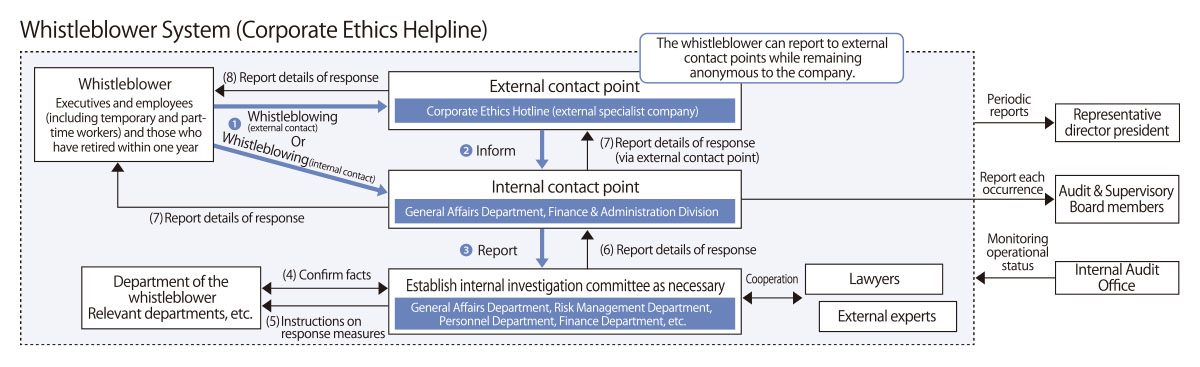
Some companies within the group have established dedicated external contact points for whistleblowing on violations of laws and regulations, internal irregularities, and acts in violation of corporate ethics by executives and employees, in accordance with the Corporate Ethics Helpline Operating Regulations. These contact points are available 24/7 and reports can be made anonymously to guarantee whistleblower protection. In addition, the Internal Audit Office regularly monitors the operational status of the whistleblower system as part of internal control.
In fiscal 2024, we received reports from whistleblowers regarding 16 different cases and a large number of the reports involved harassment in the workplace. To address the issues raised in reports, we have appropriately set the scope of information sharing and, depending on the content, consult with legal counsel. We then respond earnestly to reports and work toward resolving any issues.
Sustainability