- Home
- Sustainability
- Governance
- Corporate Governance
- Overview of Corporate Governance Structure
Overview of Corporate Governance Structure
Japan Pulp & Paper aims to maintain and improve management efficiency based on a Board of Directors consisting of directors who have thorough knowledge of the group’s businesses or possess a high level of expertise. Additionally, the company has introduced an executive officer system for the purpose of clarifying duties and responsibilities and increasing flexibility in the execution of operations to respond to rapid changes in the business environment.
In addition, outside directors participate in the process of nominating and setting the compensation for directors and Audit & Supervisory Board members and provide appropriate supervision and recommendations from an objective standpoint. Japan Pulp & Paper, as a company with an Audit & Supervisory Board, achieves enhanced monitoring and supervisory functions and transparency in decision-making by ensuring the adequate monitoring of management by the Audit & Supervisory Board, which includes outside members.
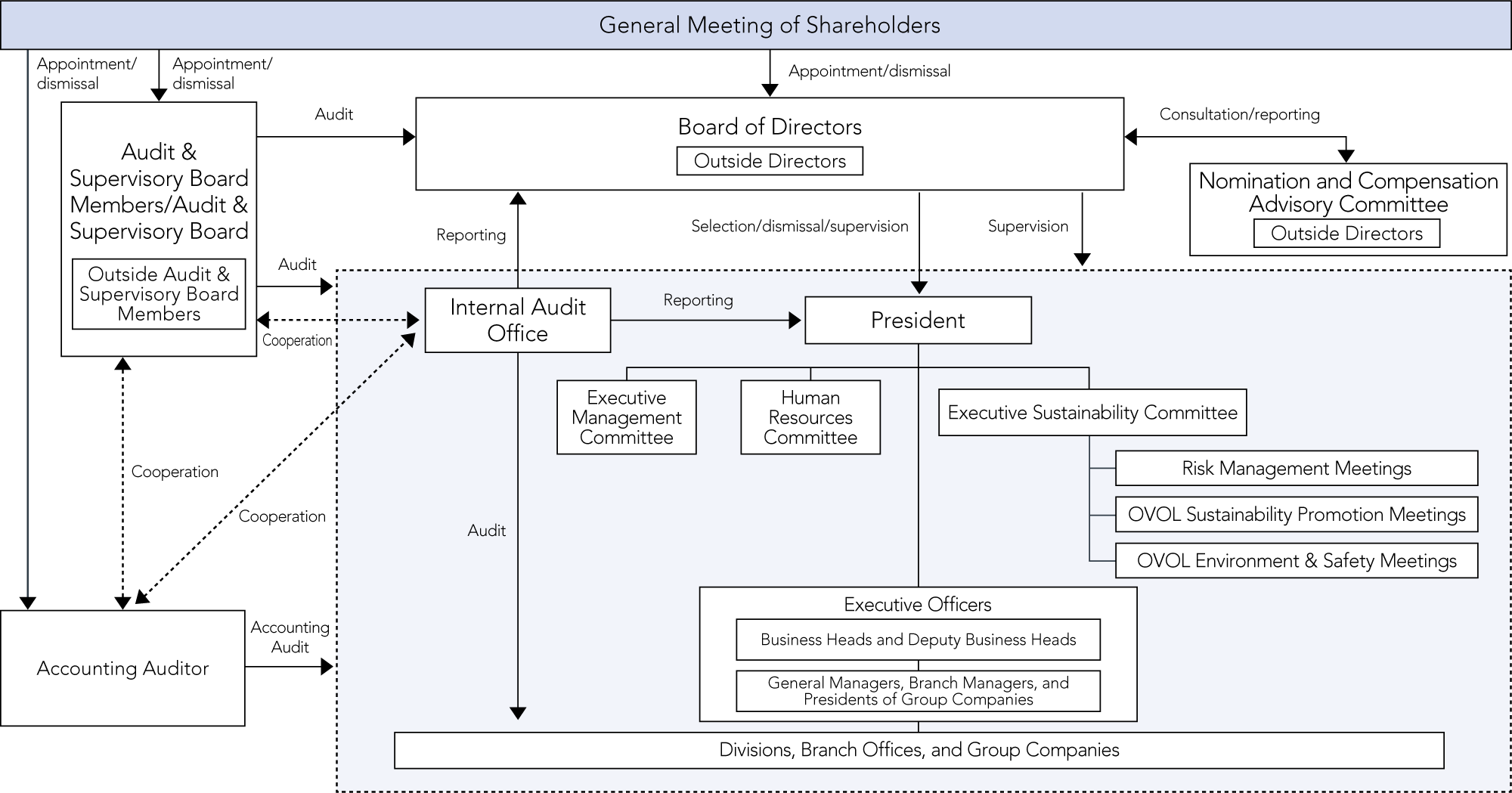
Corporate Governance Structure
Board of Directors
The Board of Directors meets regularly once a month and whenever necessary, in accordance with the law, the Articles of Incorporation, and the procedural rules for the Board of Directors. It makes decisions on matters stipulated by law and the Articles of Incorporation, as well as on important matters pertaining to the General Meeting of Shareholders; key organizations and personnel; issues involving the company’s stock; business plans; major investments; and the internal control system. The board also supervises the execution of duties of individual directors.
| Composition | 7 directors, including 3 outside directors |
|---|---|
| Number of meetings held | 17 (fiscal 2024) |
| Chairperson | Representative director, president |
| Main agenda items for fiscal 2024 | Matters related to officer compensation, head office relocation, stock splits, distribution of dividends from retained earnings, matters related to cross-shareholdings, overseas M&A, the medium-term business plan, matters related to the internal control system, and matters related to sustainability |
Audit & Supervisory Board Members/Audit & Supervisory Board
The Audit & Supervisory Board meets regularly once a month and whenever necessary, in accordance with the law, the Articles of Incorporation and the rules of the Audit & Supervisory Board. It conducts audits of Board of Directors’ proposals and the directors’ execution of their duties. It also holds liaison meetings with the representative directors once a month to exchange opinions on matters including issues the company should address, improving the auditing system of Audit & Supervisory Board members, and material issues regarding auditing.
| Composition | 1 full-time Audit & Supervisory Board member and 3 outside Audit & Supervisory Board members |
|---|---|
| Number of meetings held | 14 (fiscal 2024) |
Nomination and Compensation Advisory Committee
The Nomination and Compensation Advisory Committee was established to discuss and report on the appointment and compensation of directors and Audit & Supervisory Board members. The committee meets at least once a year and whenever necessary.
| Composition | Representative director, president (chairperson), 3 independent outside directors |
|---|---|
| Number of meetings held | 2 (fiscal 2024) |
| Main agenda items for fiscal 2024 |
|
Executive Management Committee
Based on committee rules, the Executive Management Committee meets regularly twice a month and whenever necessary to discuss significant matters concerning the group’s management and business execution, and to formulate management policies and business plans.
| Composition | Representative director, president (chairperson); full-time directors; business heads and deputy business heads; (observer) full-time Audit & Supervisory Board member |
|---|---|
| Number of meetings held | 27 (fiscal 2024) |
Human Resources Committee
Based on committee rules, the Human Resources Committee meets regularly once a month and whenever necessary in order to determine important personnel measures necessary for the strategic business development of the group, and to optimize the allocation of human resources in the group.
| Composition | Representative director, president (chairperson); the CFO (vice chairperson); business heads and deputy business heads; branch general managers of the Kansai Branch and Chubu Branch |
|---|---|
| Number of meetings held | 12 (fiscal 2024) |
Executive Sustainability Committee
Based on committee rules, the Executive Sustainability Committee meets regularly once a quarter and whenever necessary. The committee is in charge of formulating sustainability-related policies and strategies, responding to ESG-related issues, and managing the achievement of the group’s goals. It serves as the command center for promoting group-wide sustainability.
Progress updates and action plans are reported regularly to the Board of Directors, and specific initiatives related to each issue are entrusted to subordinate organizations, such as the Risk Management Meetings, the OVOL Sustainability Promotion Meetings, and the OVOL Environment & Safety Meetings.
In fiscal 2024, this committee held 16 meetings, where in addition to issuing their regular reports related to compliance, risk management, and sustainability, they deliberated on important agenda items such as responding to business and human rights, and on initiatives to reduce greenhouse gas emissions.
| Composition | Representative director, president (chairperson); full-time directors; business heads and deputy business heads; (observer) full-time Audit & Supervisory Board member |
|---|---|
| Number of meetings held | 16 (fiscal 2024) |
Executive Officers
The company has appointed a total of 30 executive officers, including four who also serve as directors as of June 27, 2025. Executive officers who serve concurrently as directors, or who are responsible as business heads or deputy business heads, oversee group business as a whole, and assist the president with each major management objective to support the achievement of common group targets. Other executive officers focus on strengthening their respective roles and improving results as general managers, branch managers, or presidents of group companies.
Sustainability