- Home
- Sustainability
- Society
- Human Rights
Human Rights
Approach to Respect for Human Rights
The group has various stakeholders, starting with its executives and employees, and including many business sites, suppliers, business partners, customers, and end users both in and outside of Japan. As a result, the supply chain is composed of stakeholders who are diverse in terms of race, nationality, cultural background, and other characteristics. Furthermore, the group is mainly involved in the paper business that uses wood as its raw material—wood has been identified as a raw material that requires particular caution due to its impact on human rights and the environment during production and processing. Therefore, since we recognize the importance of initiatives to ensure respect for human rights that encompass the supply chain, we formulated the Japan Pulp & Paper Group Human Rights Policy to clarify the group’s thinking toward human rights. Under OVOL Medium-term Business Plan 2026, we are (1) Fostering and instilling a culture of respect for human rights, (2) Implementing human rights due diligence, and identifying and addressing risks, and (3) Implementing a grievance mechanism, as a response to the United Nations Guiding Principles on Business and Human Rights.
[Related link]
Promotion Framework
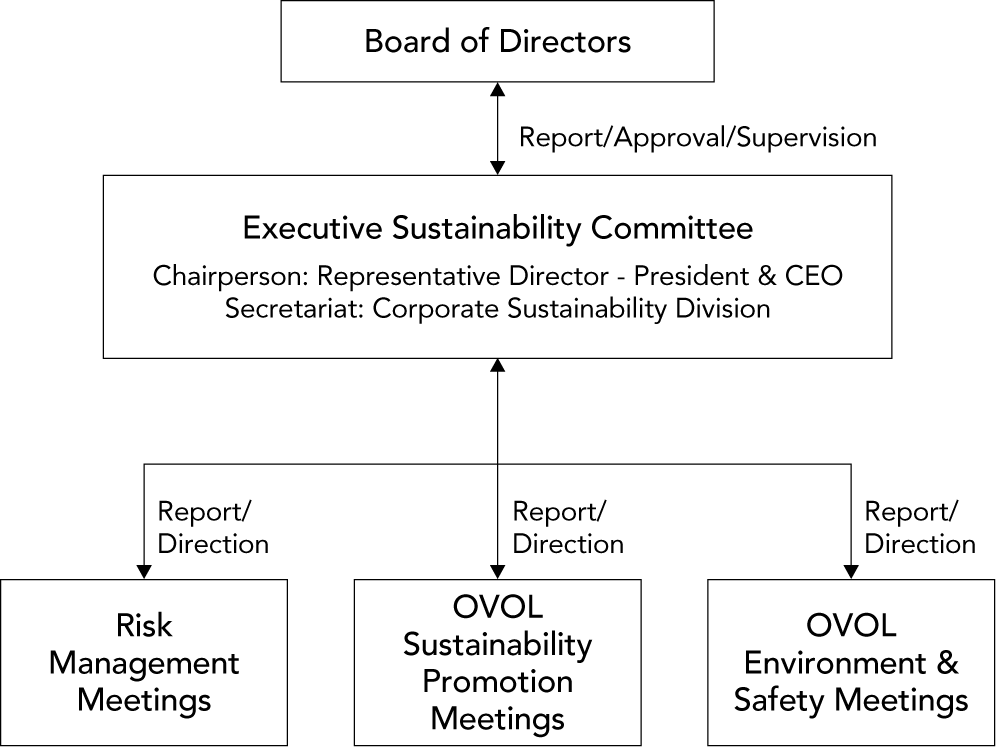
Management and employees on the ground come together to address human rights issues via the sustainability and governance structure and fulfill the company’s responsibilities to respect human rights globally. The Sustainability Promotion Office has studied proposals for responding to human rights issues and proposed specific policies, such as conducting human rights training and human rights due diligence in cooperation with the relevant departments. The details are discussed at the Executive Sustainability Committee that formulates basic policies and strategies related to respect for human rights across the entire group, and the committee promotes and monitors initiatives. Matters decided by the committee are expanded to each group site and implemented via the OVOL Sustainability Promotion Meetings. The progress of each policy is reported regularly to the Executive Sustainability Committee, and a structure has been established where key matters related to respect for human rights are monitored and supervised by the Board of Directors.
[Related link]
Implementation of Human Rights Due Diligence
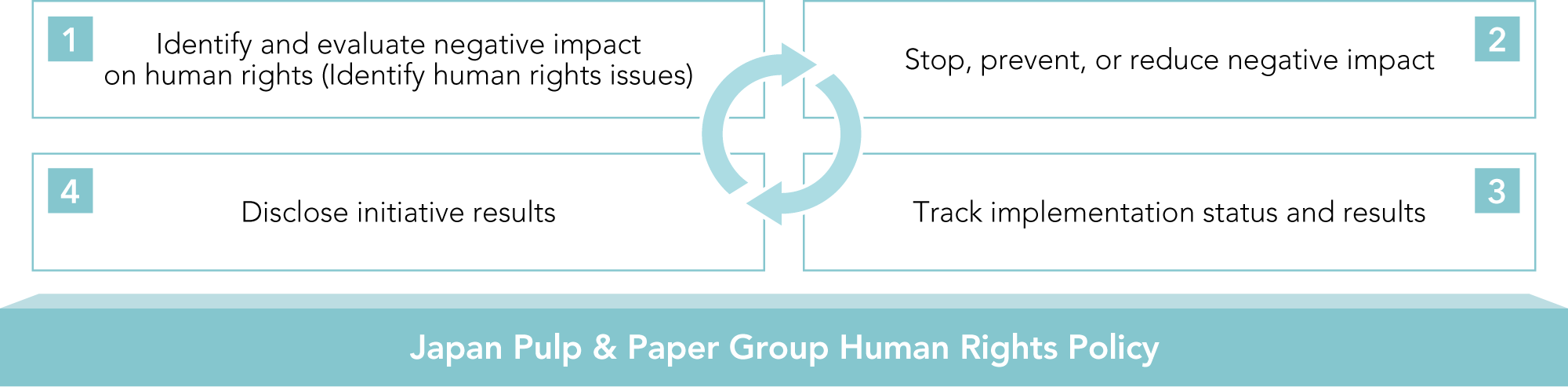
In fiscal 2024, the first fiscal year of OVOL Medium-term Business Plan 2026, the group started its human rights due diligence, based on the Japan Pulp & Paper Group Human Rights Policy, to identify the key human rights issues of the group.
Flow of Human Rights Due Diligence
Initiatives to Enhance Respect for Human Rights
In January 2023, the group signed the United Nations Global Compact, an initiative that advocates for 10 principles in the four areas of human rights, labor, the environment, and anti-corruption. We then implemented the initiatives below to enhance respect for human rights. Going forward, we will study and promote policies to address the identified human rights issues and then monitor their progress at the Executive Sustainability Committee. We will also disclose information about the processes and results of each policy as appropriate. Through these activities, we will fulfill our responsibilities to respect human rights in the business activities of the group.
Initiatives for fiscal 2024
Identification Process for Human Rights Issues at the Group
Group Human Rights Issues and Initiatives
| Human Rights Issues | Main Impacted Rights Holders | Initiatives | |||
|---|---|---|---|---|---|
| Group Executives and Employees |
Suppliers/ Business Partners |
Customers/ End Users |
Local Residents | ||
| 1. Occupational health and safety | ● | ● | Strengthening the occupational health and safety system and management | ||
| 2. Crisis management | ● | Strengthening risk management (BCP revisions) | |||
| 3. Discrimination | ● | ● | ● | Promoting diversity and inclusion initiatives | |
| 4. Harassment | ● | ● | |||
| 5. Modern slavery, child labor | ● | Strengthening supply chain management | |||
| 6. Impact on environment from procurement | ● | ● | |||
| 7. Impact on communities from business activities | ● | ||||
| 8. Violation of portrait rights, copyrights, etc. | ● | ● | ● | ● | Studying implementation of executive and employee training |
| 9. Information leakage | ● | ● | ● | Strengthening response to digitalization and information security initiatives | |
| 10. Implementation of grievance mechanism | ● | ● | ● | ● | Establishing a whistleblower system |
Sustainability